WHY ACQUIRE DIAMONDS AND GEMSTONES?

Image-GG-for-card-FINAL-500x660-web

MESSAGE FROM GILLIAN GOLDMAN CEO

“In these uncertain times, and historically, natural diamonds, gemstones and fine jewelry represent a form of portable wealth. In the event of an attack targeting our bank savings, digital currencies, or stock investments, one can rely on their jewelry as a valuable asset that can be easily transported and utilized globally. Therefore, purchasing jewelry should instill a sense of security and comfort.”

CEO
GIA Graduate Gemologist
GIA Applied Jewelry Professional
GIA Pearls Graduate


UNDERSTAND BEFORE YOU BUY

Most Diamond and gemstone purchases take the form of jewelry — the engagement ring being the single largest spend for most buyers. While jewelry doesn’t generate income, it can become a valuable asset in divorce or appreciate quietly over decades as a family heirloom. Either way, long-term value retention qualifies it as an investment.

Before you buy, Understand the FOUR Cs: Color, Clarity, Cut and Carat Weight and how they affect value and resale.

Compare Prices. Online retailers make price comparison possible for white diamonds. Colored diamonds and rare gemstones require more diligence due to rarity and limited comparables.

Buy Only Certified diamonds and gemstones. For diamonds, we recommend GIA certification. An unverified purchase is a risk not worth taking. For colored stones, GIA, SSEF, GRS, Gübelin or AIGS are reputable labs.

Engage a Professional. Engage a professional, ideally with a Graduate Gemology degree from GIA. Work with an advisor who understands quality nuances, international markets, and has direct buy/sell access to global diamond and gemstone markets. Significant Stones is that resource.


The Upsides

  1. STABILITY: Diamond and gemstone prices have trended steadily.
  2. PORTABLE WEALTH: No asset travels as discreetly as a diamond or gemstone.
  3. DURABILITY: Diamonds are among the most durable substances on earth.
  4. PRIVACY: Diamonds and gems are a private asset, can be stored discreetly or worn openly.
  5. INFLATION RESISTANT: Diamonds and gemstones tend to appreciate in line with inflation.
  6. MULTI-FUNCTION ASSET: Diamonds and gemstones can be worn and enjoyed every day without diminishing value.
  7. PHYSICALITY: You can hold it, wear it, admire it. That tangibility provides a psychological security that a brokerage statement never can.
  8. COMMITMENT ASSET: A NATURAL diamond or gemstone given as a symbol of commitment carries both emotional and financial weight.
  9. FAMILY HEIRLOOM: Few possessions survive generations as gracefully as diamonds and fine gemstones.
  10. IMPACT ON WELL BEING: “Diamonds possess an innate energy that can uplift and transform the human spirit. Wearing diamonds promote a sense of clarity and empowerment.” – Dr. Emily Collins, Psychologist
  11. ENERGETIC PROPERTIES: ​”Research conducted at the Institute of Quantum Physics has revealed that diamonds possess a high vibrational frequency, which interacts positively with the human energy field.” Dr. Michael Thompson

The Downsides

  1. Price Transparency
    Unlike gold or silver, value is set purely by supply and demand. Do your homework, and buy from a reputable, fair-dealing merchant.
  2. Lack of Tradability
    Buying is easy; selling is not. Diamond buyers exist, but most pay low prices. Only the rarest, most in-demand stones reliably find a market through auction houses.
  3. Patience is a Virtue
    Diamonds aren’t stocks — don’t expect short-term appreciation. Your money will be tied up and illiquid, and a quick resale may not return your full purchase price. At minimum, buy something you love so you enjoy owning it regardless of returns.

If you are still interested in natural diamonds and gemstones as an investment, consider them an Alternative Investment. You can still attain market exposure without buying physical stones by buying stocks in diamond-related companies.

At the very least, buy something you love. Before investing, confirm your purchase offers: price transparency, resale liquidity, market access, quality verification, and expert guidance.​​​​​​​​​​​​​​​​

Colored Stones & Diamonds: Portable Wealth, by the Numbers

Updated June 2026. Sustained appreciation across rubies, sapphires, emeralds, and fancy color diamonds, a rarity story that only deepens with time, and a form factor no paper asset can match — wealth you can carry, not a position you have to wire, store, or insure in a vault to access.

The Big 3: Steady Compounding Appreciation

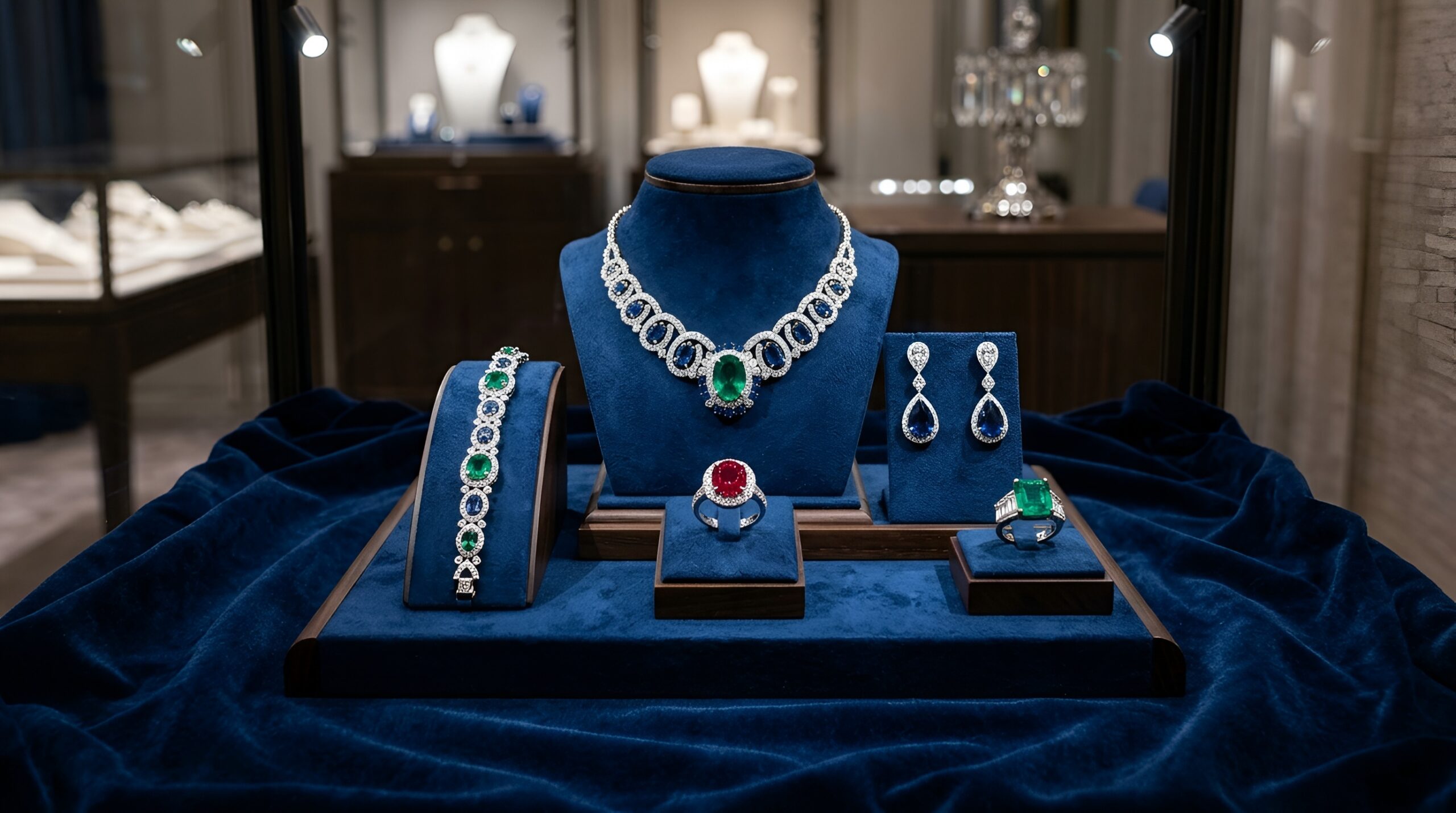
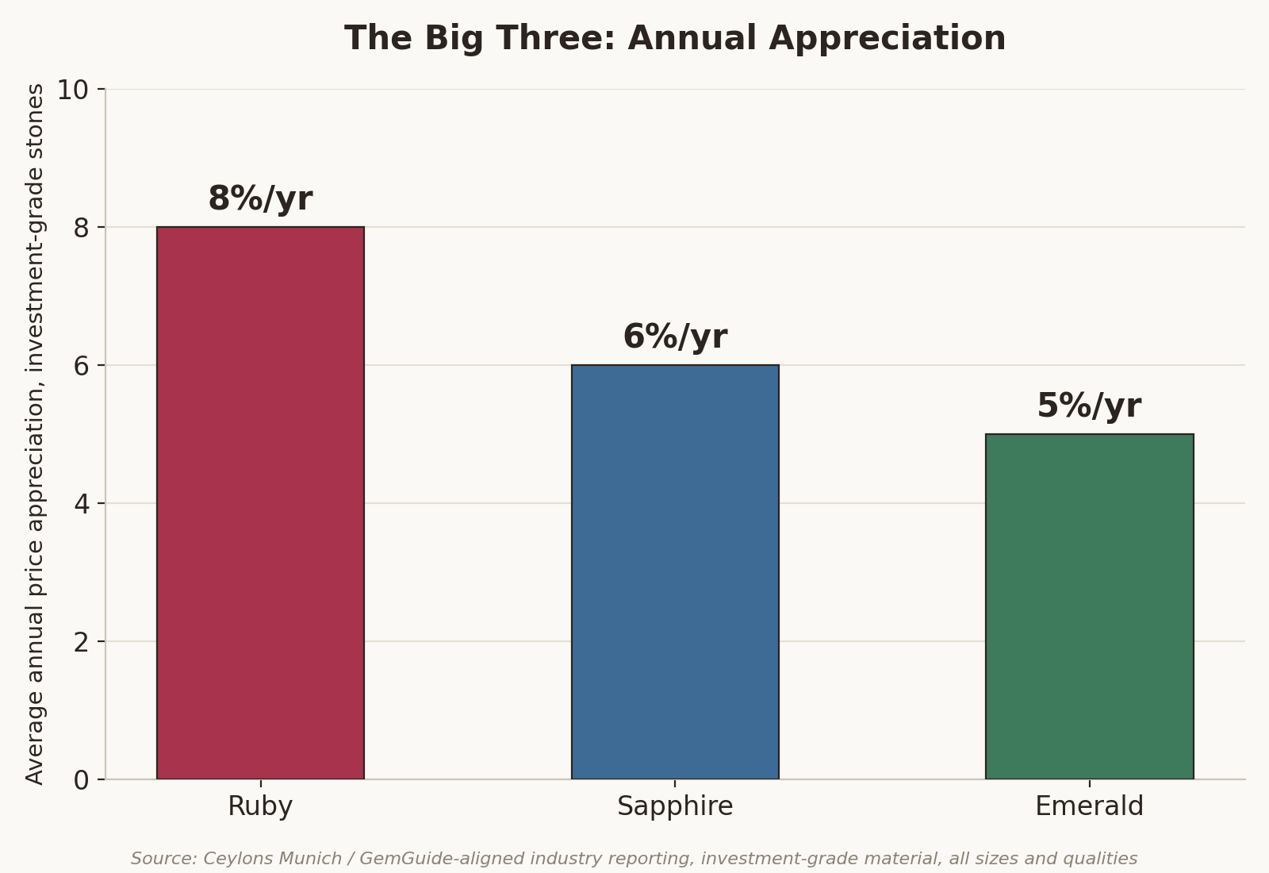
Ruby, sapphire, and emerald have anchored the colored gemstone trade for centuries, and the data behind them is remarkably consistent: investment-grade specimens of all three have appreciated every year for decades, with none of the single-year air pockets that occasionally hit other markets.

Ruby leads the category at roughly 8% annual appreciation for fine, investment-grade material — the rarest of the Big Three in large, clean, richly colored specimens.

Sapphire follows at roughly 6% annually, with the deepest, most liquid market of the three — more buyers, more auction activity, easier resale.

Emerald rounds out the group at roughly 5% annually — still comfortably ahead of a savings account or government bond, with centuries of cultural cachet behind every fine Colombian stone.

Where the Real Acceleration Happens

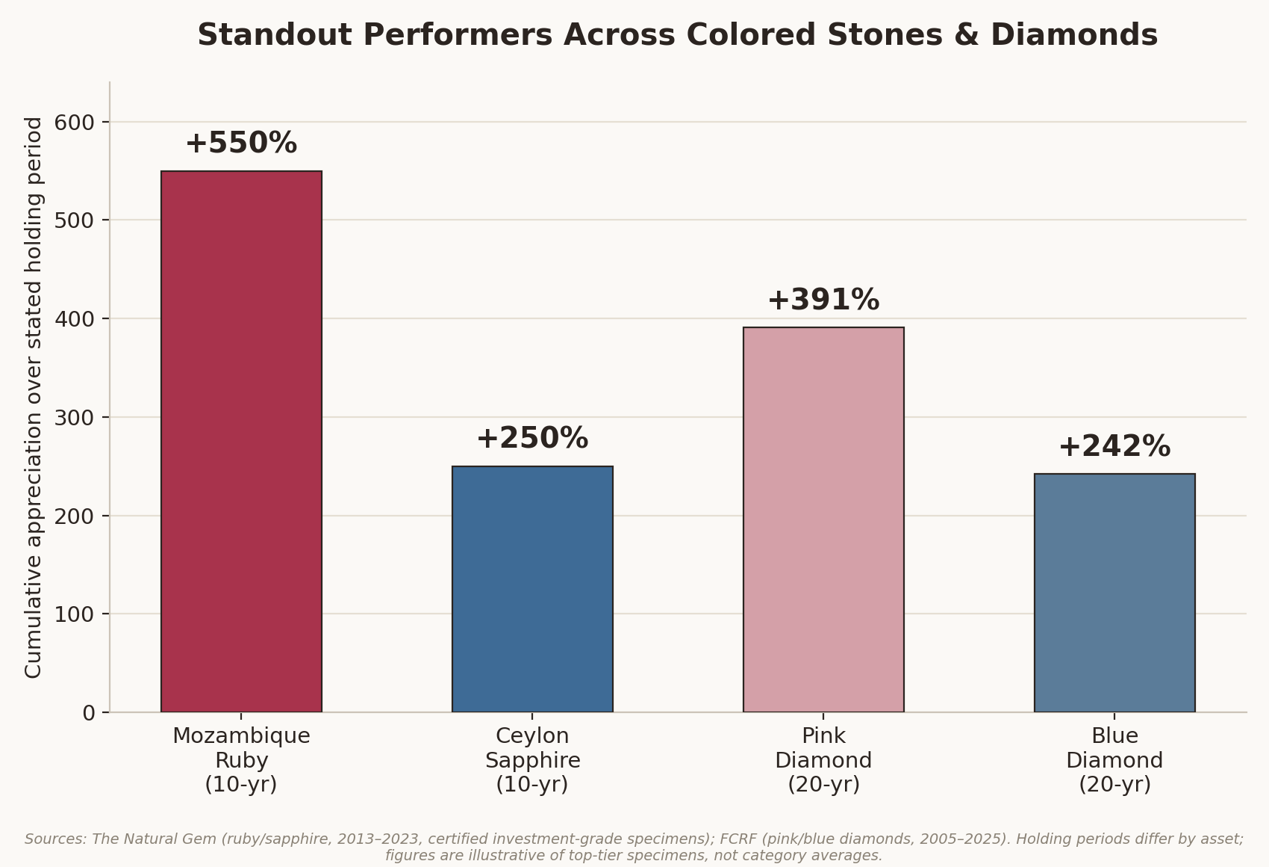
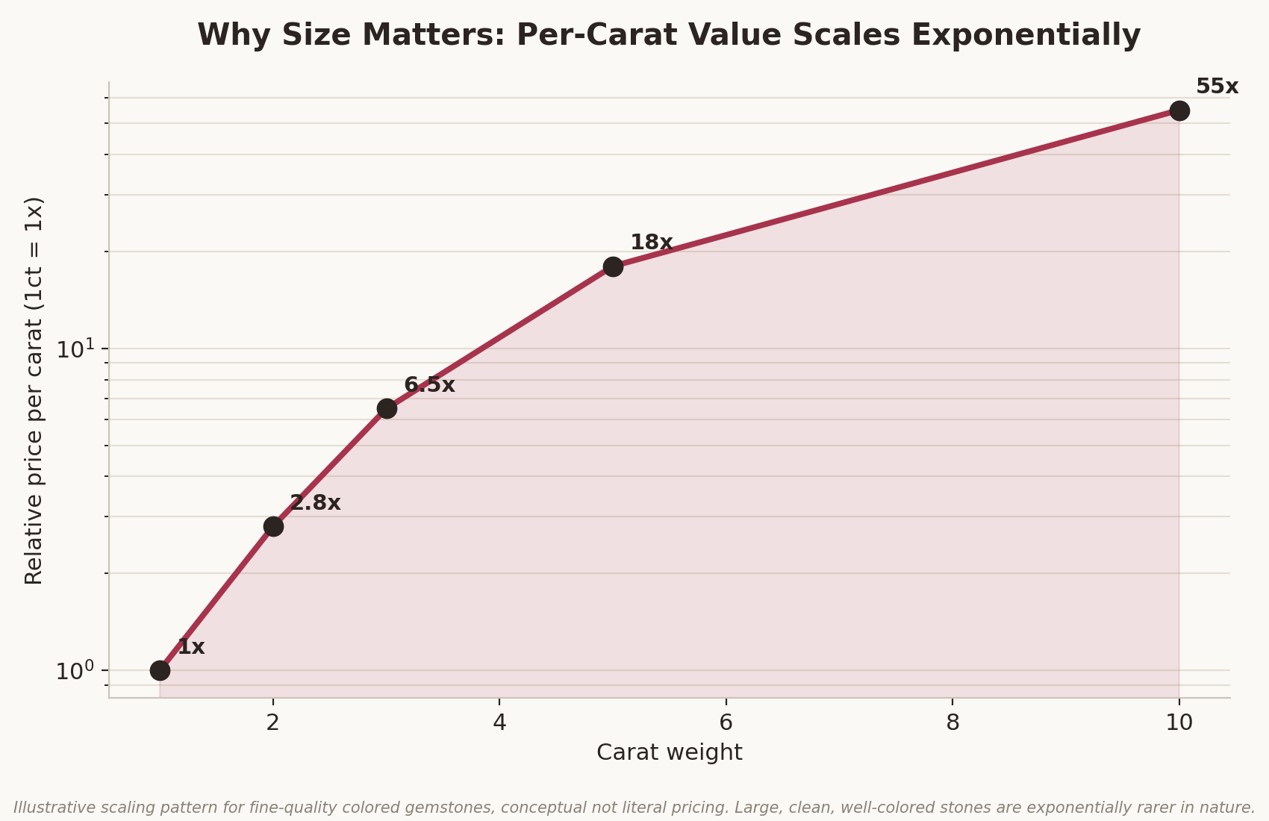
Those are blended, all-sizes averages. The standout returns live at the top end of the market, where exceptional specimens with documented origin have moved dramatically over the past decade.

A certified, unheated Mozambique ruby has appreciated roughly 550% over the past decade. A fine Ceylon sapphire is up roughly 250% over the same window. Fancy color diamonds, tracked over a longer twenty-year horizon by the Fancy Color Research Foundation, show pink up 391% and blue up 242%. Different stones, different timeframes, the same underlying story: certified rarity compounds.

Why Rarity Only Gets Tighter

Every major source behind today’s finest colored stones is constrained, and none of those constraints are loosening. Mogok, Myanmar — the historic source of the world’s finest “pigeon blood” rubies — has seen continued political instability choke the flow of new material to almost nothing, pushing dealers and collectors toward the dwindling secondary market. The original Kashmir sapphire deposits that built that name’s legendary reputation are largely exhausted. Rio Tinto’s Argyle mine in Western Australia, which once supplied roughly 90% of the world’s pink diamonds, closed permanently in November 2020 with no comparable replacement source identified since.

This is the thread that runs through every category on this page: the finest material is not being replenished. Demand, meanwhile, keeps broadening — particularly from a new generation of collectors who increasingly insist on independent certification of origin and treatment status before they buy. Tighter supply meeting deeper demand is the simplest explanation for why these markets keep compounding.

Fancy Color Diamonds: The Pink Story

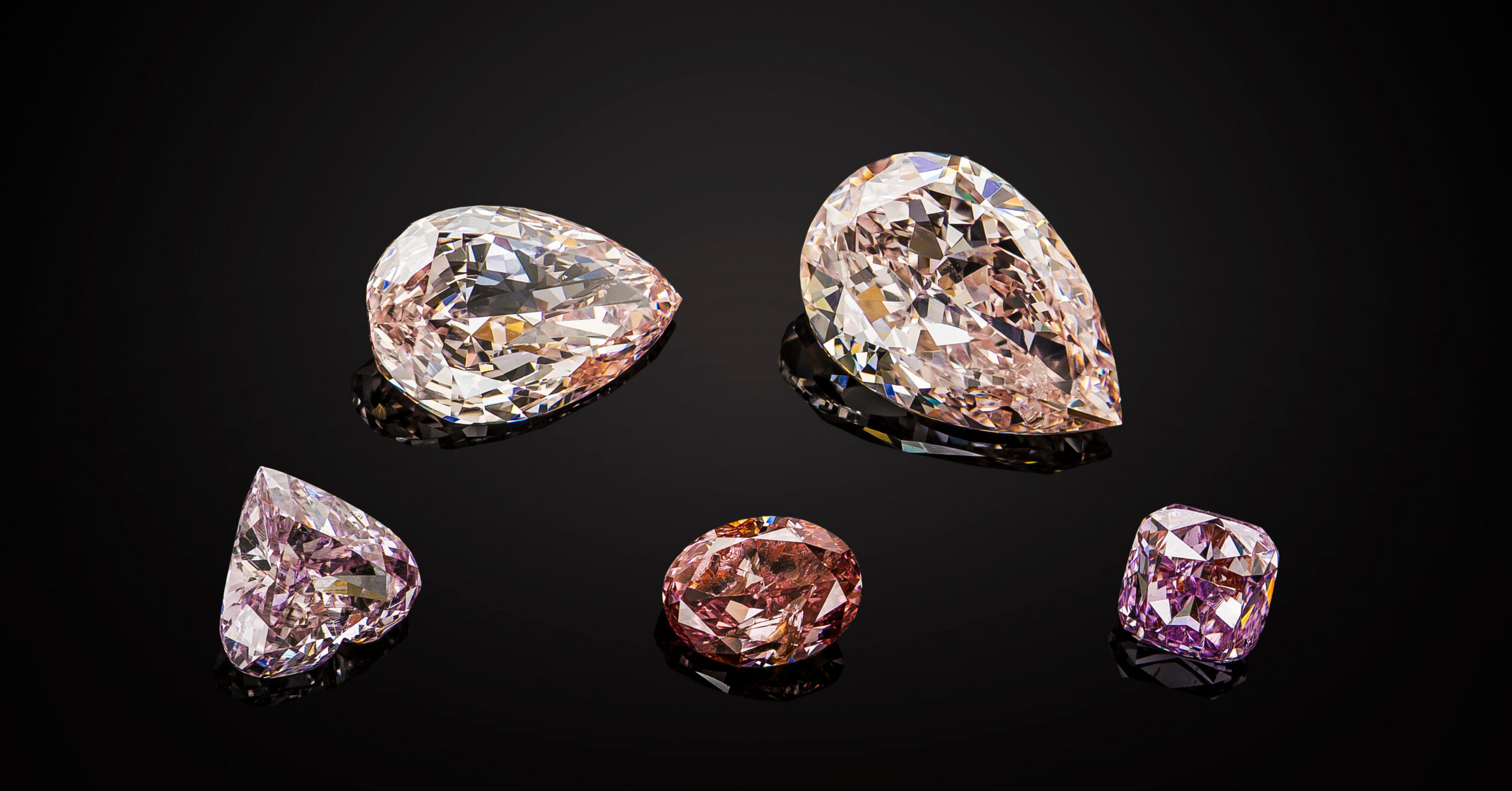
Among colored diamonds specifically, pink remains the standout. The Argyle closure described above didn’t just remove a major supplier — it removed roughly nine-tenths of global pink diamond production in a single stroke, with every other producing source combined still accounting for only a small single-digit share of supply. That structural scarcity is reflected directly in the appreciation data, and it is the clearest, most defensible rarity thesis in the natural resource world today.

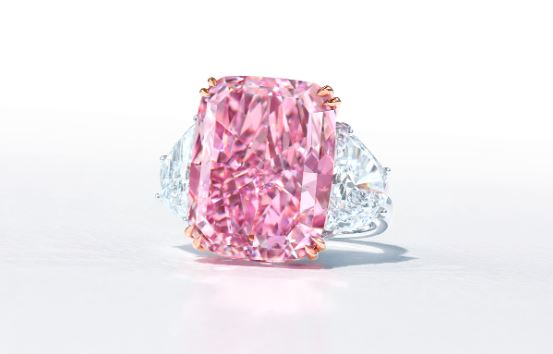
The Sakura. A 15.81 carat Fancy Vivid Purple Pink Internally Flawless Type IIa diamond ring. Sold for HK$223,412,500 on 23 May 2021 at Christie’s in Hong Kong

Fancy Color Diamonds: The Hues of Blue

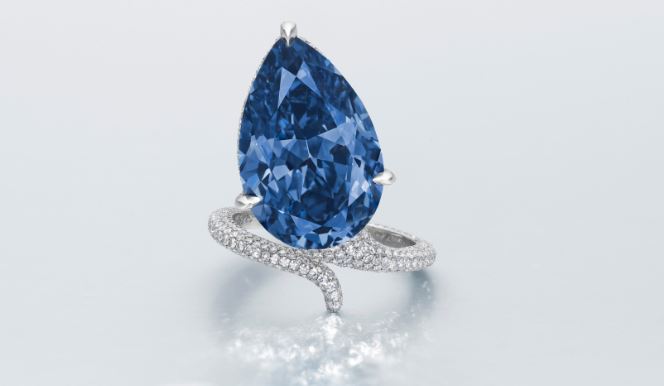
The trophy end of this market continues to set records. Geneva –The Mellon Blue, a 9.51 carat Fancy Vivid Blue achieved CHF20,525,000 | US$25,592,269, setting Christie’s third highest price for a vivid blue diamond sold at auction. Remarkable for its superb colour and extraordinary purity, the diamond previously belonged to Rachel Lambert Mellon, better known as Bunny Mellon (1910-2014), an American horticulturalist, philanthropist, and art collector. Records of this kind continue to be set periodically for exceptional pink and blue stones with flawless clarity and clean provenance.

The world’s largest blue diamond, an extremely rare gem known as “The Oppenheimer Blue”, sold for $57.5 million at Christie’s Geneva

And Colorless Diamonds?

Classic white diamonds remain the most recognized and most liquid stone in the world, with a global resale infrastructure no colored stone can match. The market has shifted in recent years as lab-grown alternatives have expanded supply at the commercial end, which has put pressure on pricing for smaller, more common natural stones. Larger, rarer natural diamonds — particularly investment-grade stones above roughly 1.5 carats with strong cut, clarity, and certification — have held their value meaningfully better through that shift, and natural stones continue to gain renewed favor for milestone purchases precisely because they cannot be replicated in a lab. For a client building a multi-generational collection, a fine large colorless diamond still belongs alongside colored stones: as the most universally recognized and most easily transacted piece in the portfolio.

The Advantage No Paper Asset Has: Portability

A percentage on a chart is only half the story. What makes that number matter is what it’s attached to. A museum-grade ruby, sapphire, emerald, or fancy color diamond worth several million dollars fits in a coat pocket. A brokerage account or a bar of gold does not travel the same way — one exists only as a database entry dependent on an institution’s solvency, the other requires assay, insurance, and physical security to move anywhere at all.

The Case for Colored Stones & Diamonds

Four things make this asset class worth holding:

Appreciation that has compounded steadily, year after year, across multiple independent markets, and generations.

Rarity, as historic mines exhaust their reserves and no comparable sources emerge to replace them.

Physical portability that no paper asset can match.

The Joy it brings the owner.

That combination is why fine Natural diamonds and colored stones belong in a long-term wealth strategy — as the holding that travels with you, answers to no one, and tends to be enjoyed every bit as much as it’s held.


Sources: Ceylons Munich and GemGuide-aligned industry reporting on ruby, sapphire, and emerald annual appreciation; The Natural Gem, citing Rapaport, Gemval, and Sukrup Gem Index data, on 10-year ruby and sapphire performance; Fancy Color Research Foundation (FCRF) quarterly press releases and Q4 2025 index report on pink and blue diamond appreciation; National Jeweler and industry coverage on Argyle mine closure and Mogok ruby supply constraints. Figures current as of late June 2026 and reflect investment-grade material; ordinary commercial-quality stones perform differently. This page is for informational purposes and does not constitute investment advice.